Harbors are a major reservoir for accepting the colossal amounts of waste generated by modem cities. Waste treatment facilities have been constructed at many harbors. Not only the dredge that is generated from the development of harbors, but industrial, municipal and construction demolition waste that is generated from the activities of the city are treated and used to reclaim land.
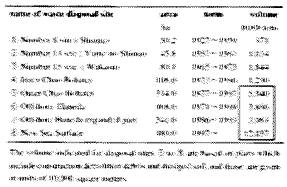
The volume of waste increases year by year. Between FY 1991 and 1995 the total volume of waste that was used to reclaim and construct sea walls reached 120 million cubic meters.
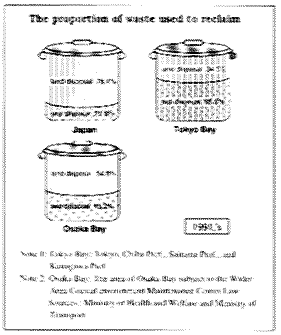
The proportion of waste used to reclaim land accounted for 20% of all waste disposal in 1991. However, land disposal in the large urban areas is becoming increasingly difficult. Today, 2/3 of the waste generated in the Tokyo Metropolitan area Tokyo, Chiba , Kanagawa and Saitama Prefectures) is disposed in Tokyo Bay. Harbors will continue to play a significant role in providing sites for final waste disposal.
Tokyo Bay Waste Disposal and Land Reclamation Process
Japan has a long history of reclaiming land by filling the sea with waste. The first such attempt occurred in the early days of the Edo period. Since then, with the urbanization of the 23 wards of Tokyo, the volume of waste has grown exponentially, and increasingly, waste has been disposed to reclaim land in the Tokyo Bay. Since the 1960's Tokyo has been totally reliant on the disposal of waste in the Tokyo Bay.
Currently a total of 15,000 tons of waste per day are being treated in the 23 wards of Tokyo combined. (combustible 70%. non-combustible 30%). The waste is used to reclaim land. Annually a total of 20 million cubic meters of construction demolition debris is generated per year. which is also used to reclaim land from the Tokyo Bay.
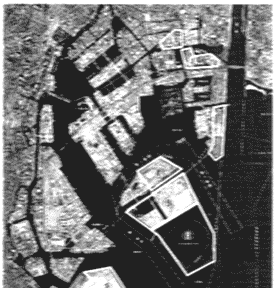
Tokyo Boy (Photo Courtesy of Tokyo Metropolitan Govt.)